
Roman Grishin
En
Predictive dialer
How we pushed agent talk time to 95%
Results:
- Agents wait no more than 40 seconds between calls.
- Agents spend 40−50 minutes per hour on active calls.
- Dropped call rate stays between 1−3% of total connected calls.
- Callers wait no more than 3 seconds to reach a live agent.
Team
Product Manager
Design — Roma Grishin
Developers & QA
Platform
Web, Desktop
Context
Why we built the predictive dialer
The outbound calling system originally ran in manual mode. An agent would pick a contact from the list, place the call, wait for someone to answer, and then move on to the next one after hanging up.
For small teams, that’s fine. But as customer bases grew and teams got bigger, it became clear this approach doesn’t scale.
Users started asking how they could speed up their outbound calling. With the manual flow, agents were constantly sitting idle between calls — and that idle time was dragging down the overall performance of their outbound campaigns.
We decided to dig deeper and understand what problems our users were actually running into when running high-volume outbound campaigns.
For small teams, that’s fine. But as customer bases grew and teams got bigger, it became clear this approach doesn’t scale.
Users started asking how they could speed up their outbound calling. With the manual flow, agents were constantly sitting idle between calls — and that idle time was dragging down the overall performance of their outbound campaigns.
We decided to dig deeper and understand what problems our users were actually running into when running high-volume outbound campaigns.
Research
What we learned about our users
- We looked at the data and analyzed how agents spent their time.
Average occupancy hovered around 40% — roughly 24 minutes of actual talk time per hour. The rest was overhead: wrapping up a call, going back to the list, picking the next contact, dialing, and waiting for a connection.
- We talked to customers running teams of 20+ agents. We talked to customers running teams of 20+ agents.
The main pain points: idle time between calls, manual dialing errors, spikes in demand during peak hours, and no real control over dialing pace.
- We looked at the market and how competitors were solving this.
Most solutions use fixed dialing rates that don’t adjust to how busy agents actually are at any given moment. This leads to either idle time or overload — especially in campaigns where activity isn’t consistent. Research shows that when occupancy drops below 70%, efficiency takes a hit; when it goes above 90%, stress and burnout risk go up.
Insights:
- Users need dynamic load balancing. Most call centers deal with uneven agent utilization — whether agents are sitting idle or queued up affects campaign results directly.
- Dialing needs to be configurable. Users want control over dial speed, timeouts, and post-answer pauses so they can tune intensity to match the campaign.
- Analytics need to be part of the picture. Users want to see how many calls are going out and whether something’s going wrong — so they can react quickly and adjust before it hurts results.
Problems
Why the old process wasn’t cutting it

Everything was just too slow
After going through the research, we pinpointed where things were breaking down:
- Manual mode doesn't scale.
As teams and contact lists grew, manual dialing couldn’t keep up. Cost per contact went up, campaign performance went down.
- Too much dead time between calls.
Wrap up, go back to the list, pick the next contact, dial, wait for a connection — that sequence adds up fast and puts a lot of pressure on agents during high-volume campaigns.
- Dialing mistakes.
When moving quickly, agents mistyped numbers or accidentally called the wrong contacts.
The Idea
How we got to predictive dialing
Based on the research and data, we landed on an approach we believed could meaningfully improve outbound campaign performance.
Our hypothesis: if we build a predictive auto-dialer that monitors team availability in real time and keeps the call flow at the right level, it will reduce idle time and speed up how fast campaigns move through contacts.
The system calls multiple contacts at once and continuously adjusts the dialing pace to keep agents busy without overwhelming them.
After launch, we planned to track outbound campaign stats, agent occupancy, and gather user feedback — while also giving users manual controls to fine-tune intensity and prevent burnout.
Our hypothesis: if we build a predictive auto-dialer that monitors team availability in real time and keeps the call flow at the right level, it will reduce idle time and speed up how fast campaigns move through contacts.
The system calls multiple contacts at once and continuously adjusts the dialing pace to keep agents busy without overwhelming them.
After launch, we planned to track outbound campaign stats, agent occupancy, and gather user feedback — while also giving users manual controls to fine-tune intensity and prevent burnout.
Solution
How the new calling flow works
The system looks at agent performance data, answer rates, and average dial time — then figures out the right number of simultaneous calls to place so that when an agent wraps up, there’s already someone on the line waiting.
Typically, the system is placing 3−5x more calls than there are available agents.
Typically, the system is placing 3−5x more calls than there are available agents.
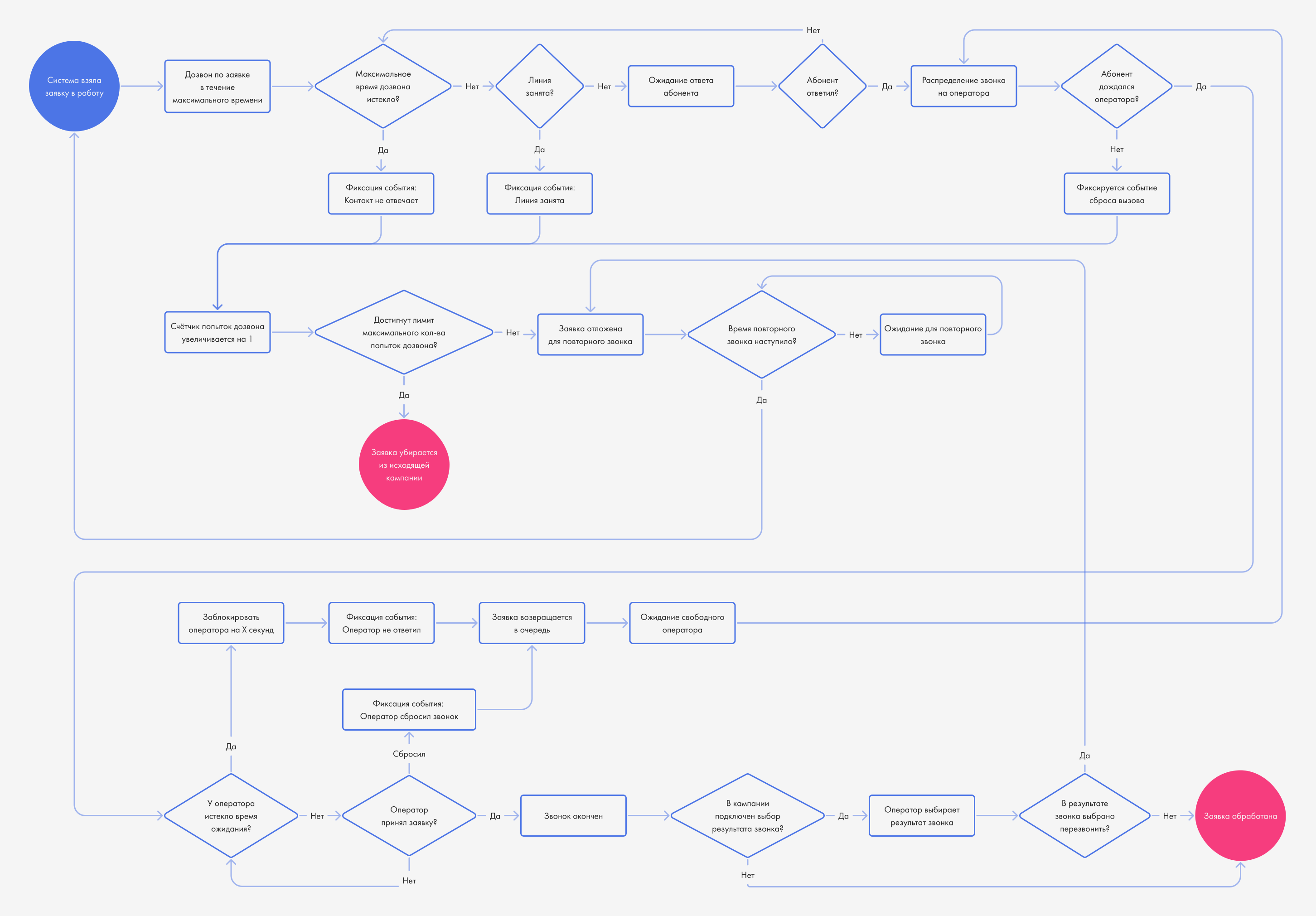
How the predictive dialer works
That might sound like a lot, but the stats back it up — on average, only 20−25% of contacts actually pick up. Answer rates depend on:
- the quality of the contact list,
- the type of number being used to call,
- the time of day.
To keep the pace steady without overloading agents, the algorithm analyzes and predicts team behavior based on:
- average call duration,
- average agent idle time,
- average wrap-up time after a call,
- current agent occupancy,
- contact list answer rate.
When you launch an outbound campaign, predictive dialing settings are configured automatically. Users can also manually adjust dial pace, pause intervals, and other parameters.
Predictive dialer settings in an outbound campaign
Predictive dialing works best at scale. The system automatically adjusts pace and cuts down the time agents spend waiting between calls.
Testing
How we validated the solution
We ran the predictive dialer in a test mode for outbound campaigns and watched how it held up in real conditions.
Agent workspace
The main things we were watching:
- How comfortable agents felt working at the new pace.
- Whether campaign settings were clear and flexible enough.
- Agent occupancy levels.
- Dropped call rate.
- Overall campaign performance.
Results
What changed after launch

- Wait time between calls during high-volume campaigns stays under 40 seconds.
- Agent occupancy jumped from 40% (24 min/hour) to 78% (46.8 min/hour) — meaning agents are spending most of their time in actual conversations, not on manual busywork.
- Dropped call rate stayed within 1−3%, which is within acceptable range.
The feature sped up outbound campaigns by cutting down dead time between calls and distributing workload more evenly across the team.


What's next
Where we’re taking it
Shipping the predictive dialer opened up new doors — for us and our users. We built something competitive, and larger call centers started reaching out more often, looking for a solid outbound campaign solution.
We’re continuing to track how the predictive mode performs, collecting user feedback, and iterating on the rough edges.
We’re continuing to track how the predictive mode performs, collecting user feedback, and iterating on the rough edges.